
The Almost-Summer Heart
10 Heart Beats for June

Dear friends,
This month’s Heart Beats is a full basket: poems, peaches, libraries, stars, writing invitations, links, and two free downloads. It’s meant to be dipped into, returned to, and savored throughout June.
I hope you find something here that helps you notice, write, rest, and feel a little more wonder.
Subscribe to Get All Access!
If you’re new here, welcome. I’m so glad you found your way. Subscribing is free and gives you access to my monthly Heart Beats, free downloads and my Library of Resources for teachers and writers.
If you ever choose to become a paid subscriber, thank you. Your support helps me keep creating poetry resources and invitations. But truly, I’m grateful you’re here in whatever way feels right for you.
❤️10 Heart Beats for June
Peaches, Libraries, Stars, and Thanks
❤️1. ode to teachers
If you’re a teacher, you may already be on summer break, or you may still be heading toward the finish line.
I want to begin this newsletter by saying: THANK YOU!
Thank you for every child you noticed. Every question you made room for. Every small bit of courage you helped grow.
Pat Mora’s Ode to Teachers written from the voice of a student looking back shows how a teacher’s belief in a student can live inside a child for years. Here is the final stanza:
I carry your smile
and faith inside like I carry
my dog’s face,
my sister’s laugh,
creamy melodies,
the softness of sunrise,
steady blessings of stars,
autumn smell of gingerbread,
the security of a sweater on a chilly day.
writing invitation: an ode of thanks
Think of a teacher, student, librarian, friend, or mentor who believed in you and helped you feel braver. You might want to begin with…
Because of you, I…
or
I carry your…
Write for ten minutes. Don’t worry about making it a poem. Just begin with thanks.
📎 Download: An Ode of Thanks Heart Map
A place to gather memories, images, and words for someone who helped you feel braver.
❤️ 2. sweet peaches
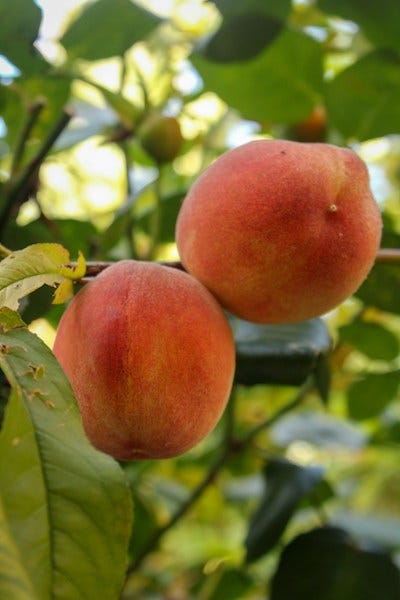
Li-Young Lee’s poem From Blossoms is a love poem to peaches, to being alive, and to love.
Here are the final lines of the poem:
…
O, to take what we love inside,
to carry within us an orchard, to eat
not only the skin, but the shade,
not only the sugar, but the days, to hold
the fruit in our hands, adore it, then bite into
the round jubilance of peach.
There are days we live
as if death were nowhere
in the background; from joy
to joy to joy, from wing to wing,
from blossom to blossom to
impossible blossom, to sweet impossible blossom.
Maybe this is the week to buy peaches, eat one over the sink, juice running down your wrist. Or better yet, share the love, and make a peach pie (NY Times recipe) while reading From Blossoms.
❤️ 3. microseasons
The traditional Japanese calendar is divided into 72 kō, or microseasons. Each five-day kō describes a haiku-like image from the natural world.
June 6 - 10: praying mantises hatch
June 11 - 15: rotten grass becomes fireflies
June 16 - 20: plums turn yellow
A friend said to me recently, “Florida has only one season, doesn’t it?” No, it actually has multiple microseasons if I pay close attention to what’s around me. I wrote a few of my own June kōs:
June 6 - 10:
thunderclouds pile up like meringue in the western sky
trails of green tree frog footprints cross the glass door at night
sea turtles crawl silently onto sand to lay their eggs
writing invitation: write your own june microseason or kō
Look around. Write your own kō of the next five days. What’s the world like? What changes do you see? What appears? What disappears? What does the air feel like? What are the plants, birds, insects, clouds, and creatures doing?
❤️4. wonder, why now?
Have you ever felt wonder-less?
The things that usually lift you — trees, clouds, birds, poems — don’t quite reach you in the same way.
After my mother died, I felt exactly this way: wonder-less. But you don’t need to have a death in the family to know how this feels. Sometimes the weight of the world is enough. Sometimes exhaustion is enough.
And still, somehow, the way back to wonder always begins with wonder.
Dacher Keltner, author of Awe, wrote that after his brother passed away he felt wonder-less. His way back to wonder was to go on awe walks. Here are Keltner’s Instructions:
Tap into your childlike sense of wonder…. During your walk, try to approach what you see with fresh eyes, imagining that you’ve seen it for the first time. Take a moment in each walk to take in the vastness of things, for example in looking at a panoramic view or up close at the details of a leaf or a flower.
writing invitation: go on an awe walk
Go for a ten-minute walk. Don’t try to find something amazing. Just be present. Feel that tiny tug at the heart when wonder returns.
❤️5. wonder rooms

When Rebecca Kai Dotlich and I wrote Welcome to the Wonder House we organized it around twelve Rooms of Wonder: Room of Imagination, Room of Creatures, Room of Ordinary Things, and more.
Recently, Jen McDonough (my co-author of the forthcoming 2nd edition of A Place for Wonder) read Welcome to the Wonder House to fourth graders, and invited them to dream up their own rooms of wonder. Here are some rooms of wonder that they dreamed up:
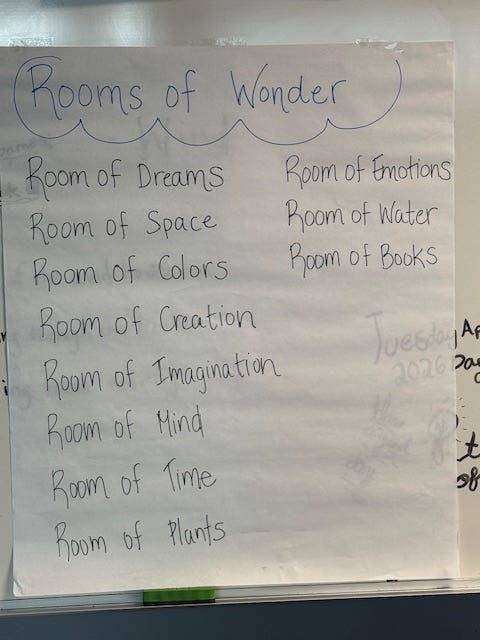
I look forward to writing some new poems from their rooms of wonder.
writing invitation: wonder rooms
Write a list of what rooms of wonder would be in your wonder house.
The Room of Lost Things?
The Room of Clouds?
The Room of Almost Remembering?
Create your own wonder room, and step inside by writing a poem.
📎 Download: 10 Doorways Into a Summer Poem
A one-page invitation for teachers, writers, or anyone who wants a doorway back into writing.
❤️6. let summer reading begin
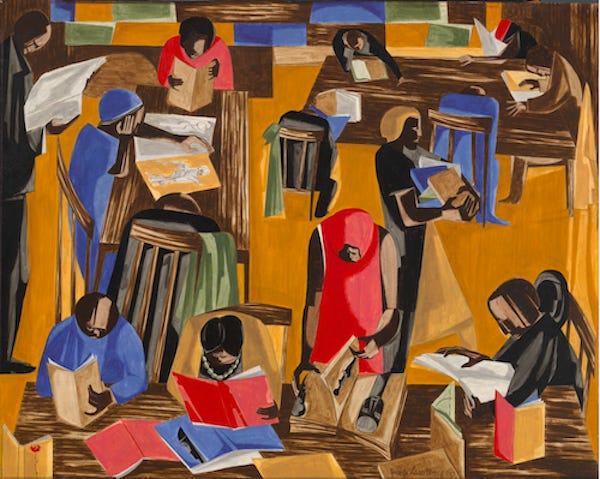
When I look at Jacob Lawrence’s painting The Library, I think of the joy of reading.
My mother was the librarian at our school, and I spent many afternoons waiting for her to finish before we all headed home. I remember wandering the shelves, choosing a stack of books, and sitting in the library reading and feeling time slip by.
In this moment when books are being challenged and banned in schools and libraries, the freedom to choose our own books feels even more precious. Children deserve books that open doors, widen the world, and offer them places where they can find themselves.
writing invitation: write an ekphrastic poem
Write an ekphrastic poem (a poem about art) in response to Lawrence’s The Library.
Look closely at The Library. Choose one person, one image, one corner. Let the painting lead you to a memory or an image: a library you love, a memory of getting a library card, a book you can’t put down.
I hope you’ll share a few lines of your ekphrastic poem in this newsletter’s comments. I’d love to read what the painting opened for you.
❤️7. summer stars
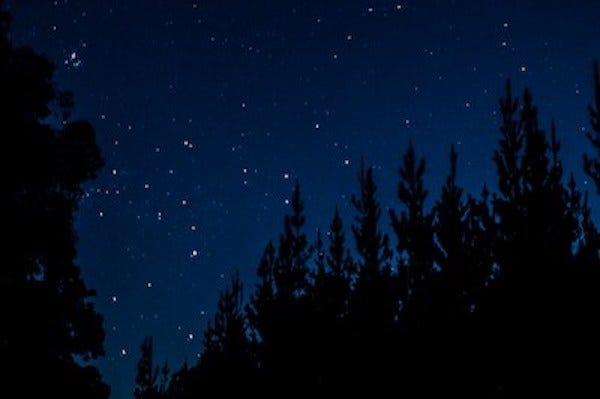
Carl Sandburg’s Summer Stars feels like lying on your back in the grass and
hum-strumming as you gaze up at the night sky.
Summer Stars
Bend low again, night of summer stars.
So near you are, sky of summer stars,
So near, a long-arm man can pick off stars,
Pick off what he wants in the sky bowl,
So near you are, summer stars,
So near, strumming, strumming,
So lazy and hum-strumming.
After reading Summer Stars, go outside one night and open the Sky Guide app. Point your phone upward and learn the names of stars, planets, and constellations.
I love the mixture of old and new: a poem in one hand, a phone in the other, and the ancient sky above.
❤️8. may love stay close
This month I’m holding close my good friend’s daughter, who has just finished chemotherapy and is heading to MD Anderson for radiation, and my dear friend who is finishing up radiation too.
For them, and for everyone carrying something hard into summer: may courage come in small doses, may rest find you, and may love stay close.
When my friend’s daughter was first diagnosed, I sent her Lucille Clifton’s poem “blessing the boats.” It was one of those poems I hoped might offer a little courage, a little steadiness, a little way through.
You can read the poem here: [blessing the boats by Lucille Clifton]
If someone is going through a hard time, maybe send them a poem. Maybe this one. Sometimes a poem can help carry us through.
❤️9. nikki grimes and the golden shovel
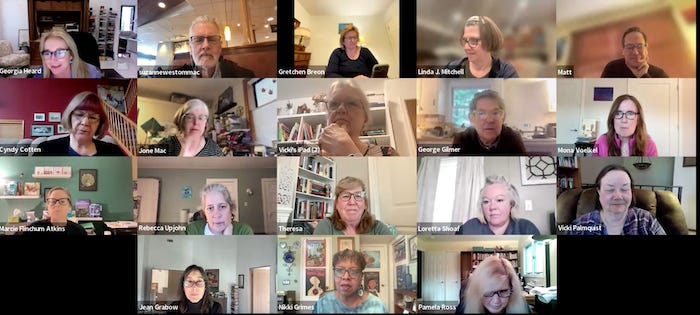
Nikki Grimes was my guest at The Poet’s Studio last month, and we had such a wonderful evening. One of the invitations she gave us was to write a Golden Shovel poem.
The Golden Shovel form was created by Terrance Hayes. You take a line from another poem (called a striking line) and use each word as the last word of each line in your own poem.
I love how the form feels like stitching. A line from another poet becomes the thread, and then your own poem grows around it.
One of the poets in our workshop, Mona Voelkel, wrote a wonderful Golden Shovel poem using a line she loved from Ada Limón’s Instructions on Not Giving Up. I’m grateful to share it here.
May Return
Outside my window, green leaf unfurling,
I am singing each budburst like
Persephone rising from a
cleft; her mother’s fist
unclenching to
behold: Green is an
exhalation, an exultation, an open palm.
writing invitation: the golden shovel
Choose a short line from a poem you love. Let each word become the last word of a new line. Let the borrowed line lead you somewhere unexpected.
❤️ 10. a song for teachers: we get by
I want to end where I began: with teachers.
This song feels like a hand on the shoulder, a hug, after a long year.
For every teacher who carried students, stories, worry, laughter, and exhaustion through another school year: thank you.
You made it this far.
We get by.
As we move into summer, I’m looking forward to new ways we can write and learn together at The Poet’s Studio. Here’s what’s coming up, with more workshops on the way.
From The Poet’s Studio
Words That Sing And Soar: The Joy of Words in Poetry
with special guest Irene Latham
Wednesday, August 12, 2026 | 7:00 to 9:00 PM ET
Early bird pricing: $75 through July 1st | $85 after July 1st

I’m delighted that Irene Latham will join us for part of the evening. Irene will share from her new book Come In! Come In! Wordspinners to Welcome You Home and talk about inventing words, the “nature” of words, and playful, surprising language in poems for children. She’ll also lead us in a writing invitation.
Together we’ll read poems, talk about language, and try exercises to help us find fresher, livelier words for our own poems.
Whether you’re a teacher, a writer, or both, summer can be a beautiful time to refill the creative well.
[Learn more about The Poet’s Studio]
Thank you for being here with me. I hope this basket of poems, links, and June things keeps you company and helps wonder find its way back.
If these words found you at the right moment, you’re welcome to share this with someone who might need them too.
All subscribers have access to my [Heart Beats Library of Resources], filled with poem invitations, classroom tools, printable downloads, and other small offerings for teachers and writers. These resources are made with love, and I’m grateful to share them with you.
And if you ever feel moved to become a paid subscriber, thank you. Your support helps sustain the time, care, and heart that go into creating this newsletter and these resources. If that’s something you’re able to do, I’m deeply grateful.
Thank you for all these wondrous June invitations, Georgia, and for including my poem! I am so honored! Thank you also for your inspiring class with Nikki Grimes, and to Ada Limón for "Instructions on Not Giving Up" from which it came. LOVE all the rooms of dream the students came up with, and looking forward to the 2nd edition of A Place for Wonder, as I loved the 1st edition so much!!! Yay!
Lovely congrats to Mona! And lovely tribute to Ada Limon!
Happy June musings! Thanks.